The Review Commons
A working prototype of peer review that is funded, blinded and signed.
Open camsmith.xyz/commons ↗Peer review runs on unpaid time. Reviewers donate their hours, their work leaves no record they can carry, and a reader can't see what was actually checked. The Review Commons is a prototype of the fix: review that is paid, blinded and signed.
It starts by breaking research into small pieces called chunks: a finding, a citation, an open question. Each one carries a stable ID, a trace back to the person or source it came from, and a disclosure level. That shared unit is what lets work from very different fields be compared and reviewed the same way. The commons is a translation layer, not a journal.
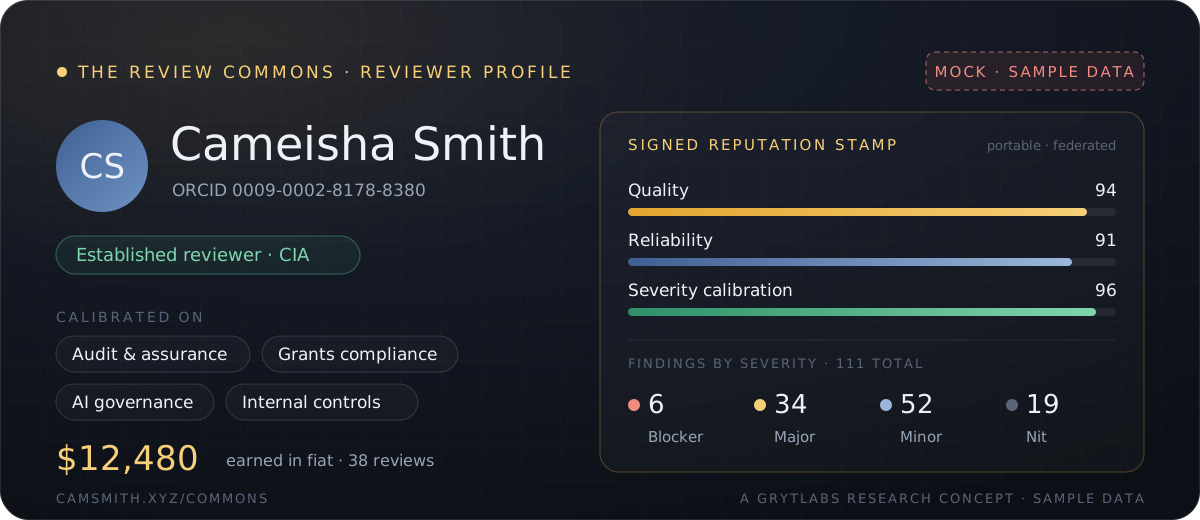
Funders post review bounties in plain money, with no token in between. Reviewers choose work they're qualified to check without seeing who wrote it or who paid for it, and no one can fund or review their own work. Every finding has to point at a specific chunk, and the rubric is fixed by the type of work, so neither side can shape it. Each finished review mints a reputation stamp, signed and tied to the reviewer's ORCID, that travels with them.
Publications become views over the commons: they cite chunks by ID, and a check confirms a publication faithfully reflects the chunks it cites. That proves integrity, not truth. Two questions stay open: how a reputation stamp grows, fades or gets revoked, and how funders, authors and reviewers all arrive at once. The idea began as a GrytLabs research concept. Everything in the prototype is sample data.
Made possible by:
CamOpus 4.8Opus 5.5Opus 5.5Opus 5.5